
Existing feed-forward Gaussian Splatting methods can't scale to
4K.
LGTM is the first native
4K feed-forward method that predicts compact
textured Gaussians.
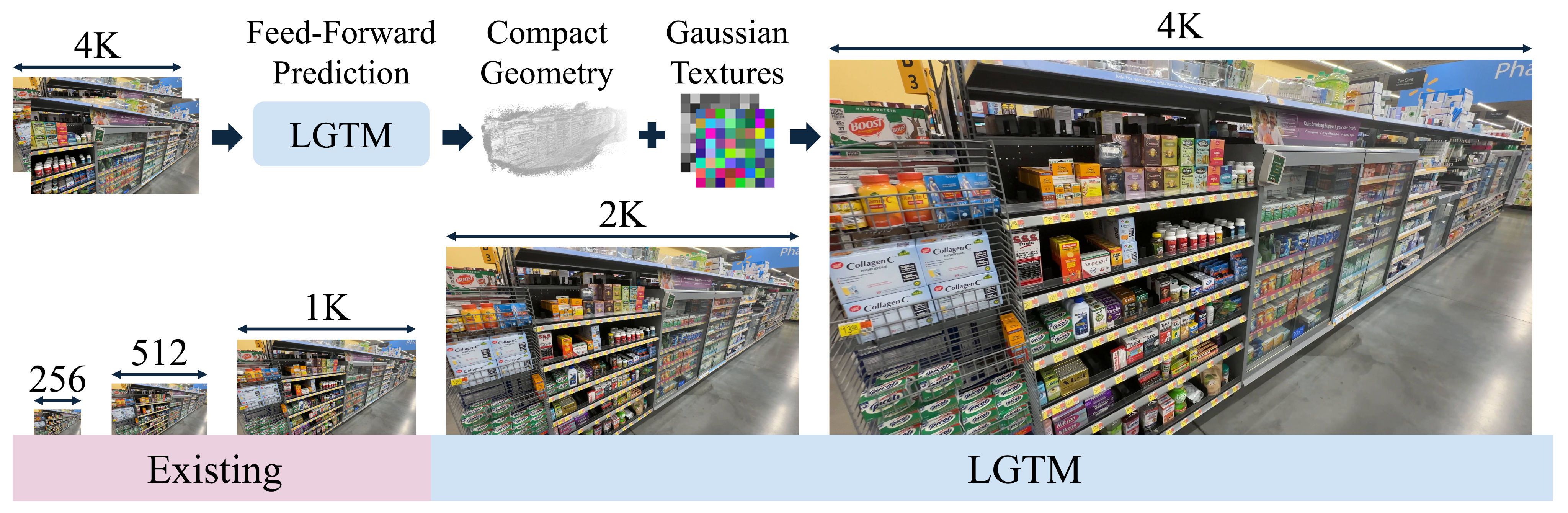
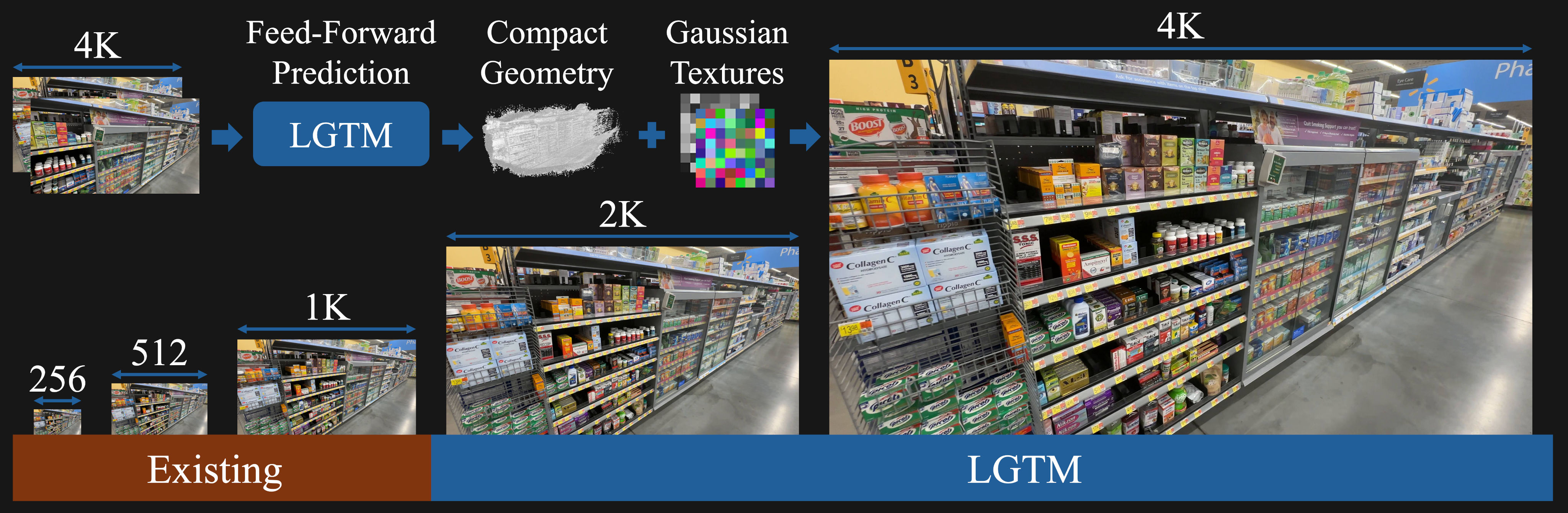
How LGTM Works
Existing feed-forward 3D Gaussian Splatting methods predict pixel-aligned primitives, leading to quadratic growth in primitive count as resolution increases. This fundamentally limits their scalability, making high-resolution synthesis such as 4K intractable. Additionally, standard 3DGS couples appearance and geometry within each primitive, requiring excessive Gaussians to represent rich texture regions on geometrically simple surfaces.
We introduce LGTM, the first native 4K feed-forward method for Gaussian splatting. LGTM supports native 4K inputs and predicts native 4K output in a single feed-forward pass. LGTM jointly trains:
- Gaussian primitive network: Predicts a compact set of Gaussian primitives.
- Texture network: Processes high-resolution inputs to predict per-Gaussian RGBA texture maps.
By predicting compact Gaussian primitives with per-Gaussian texture maps, LGTM decouples geometry from rendering resolution and enables:
- Native 4K reconstruction: Takes 4K inputs and predicts 4K output in a single feed-forward pass.
- Quadratically fewer Gaussians: Uses T2 fewer Gaussians to render the same image resolution.
- Sharper visual details: Improves high-frequency texture reproduction with per-Gaussian texture maps.
- Plug and play: Works with monocular, two-view, and multi-view baselines, with or without known camera poses.
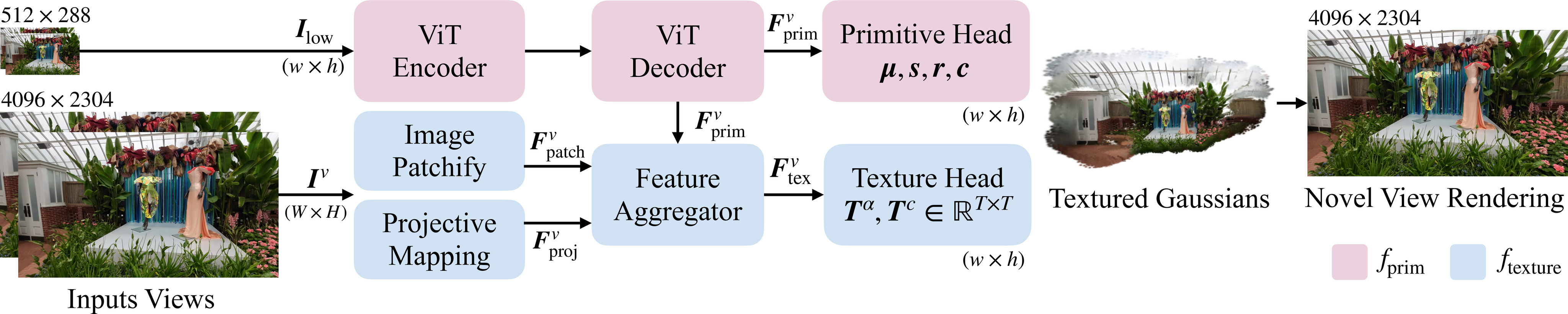
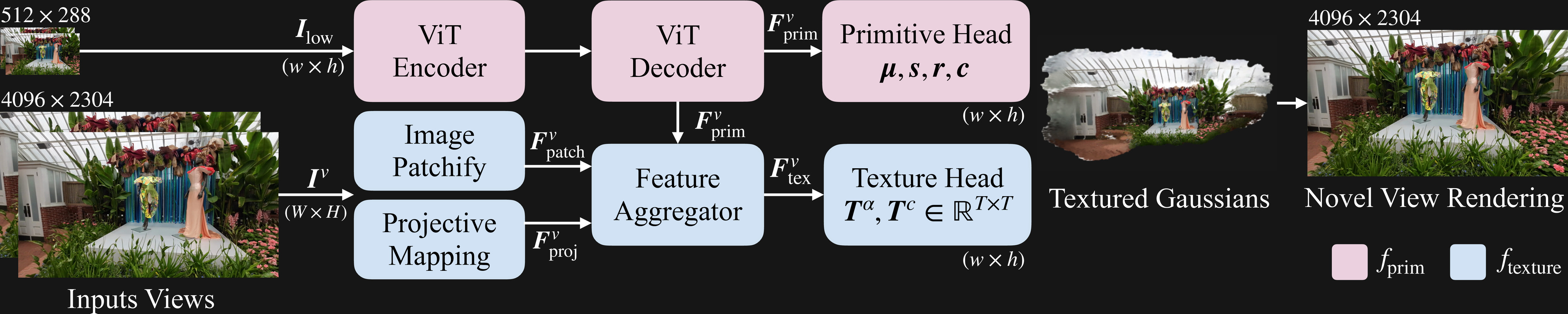
Image Comparisons
Single-View Inputs
Compared to Flash3D, LGTM produces finer details with textured Gaussian prediction.
Two-View Inputs
LGTM works with both unposed (NoPoSplat baseline) and posed (DepthSplat baseline) settings.
Citation
If you find our work useful in your research, please consider citing:
@inproceedings{lao2026lgtm,
  title     = {Less Gaussians, Texture More: 4K Feed-Forward Textured Splatting},
  author    = {Lao, Yixing and Bai, Xuyang and Wu, Xiaoyang and Yan, Nuoyuan and Luo, Zixin and Fang, Tian and Nahmias, Jean-Daniel and Tsin, Yanghai and Li, Shiwei and Zhao, Hengshuang},
  booktitle = {ICLR},
  year      = {2026},
}